Oh. It appears that I have been summoned.
You guys have quite a bit of this figured out. Although, I will say that you could store entire libraries in a single property by searching for substrings in text. This would also cause the system to require less blocks, because you wouldn’t need the massive elif to pick randomly from a library.
6 Likes
wait this is literal gold
Is there a property character limit?
6 Likes
so if the device detects a said sentence like “Who is the best soccer player”
chain it with random numbers to have input give a 50/50 answer
“Messi” or “Ronaldo.” Have said feedback able to integrate the previous input in said way creating a RNG (random number generator) and by having each word paired to a number you use code to decide the number of “Messi” as 003 and the sentence as “123 68 9273 808990 563417” when the machine recognizes the sentence it should run code stating as a 50/50 answer by flipping a coin giving back either “003” or “0000067” which then translates to Messi or Ranaldo. Am I right in this theory of what you are trying to say?
Edit: No one telling me if I am right 
2 Likes
According to this old ahh post, the property character limit is 256, but you can set it to a string 512 characters long in blocks.
We should be able to store 1 library per property in our 128 property placement limit.
6 Likes
Okay so this does change a lot, but can you explain how I would do it?
I’ve never used property strings before…
2 Likes
Okay I have the AI functioning, can’t post proof for a bit (algebra class, and a science test to study for)
Please update me on any findings while I’m gone.
2 Likes
A string is just a set of characters. It’s the quotation mark block in the menu.
Something like this:
Set Property (“library2”)
Value (“I dunno man      [insert thing]   16CharactersName<-Str separation”)
4 Likes
Okay I couldn’t record it but…
Here’s what I have so far
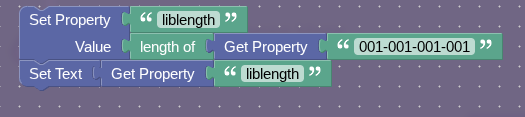
Library 001-001-001-001 (basic function words) I will have to rework this due to @some_kid pointing out that I can use text strings for a lot more storage.

Library searcher

“how”
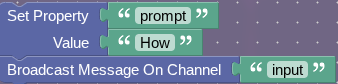
This is all wired to a text device
4 Likes
Extension of previous post:
Each entry in a library would have 16 characters, allowing for 16 entries in each library. If you wanted you could take it down to 8, doubling the number of entries per library, but halving maximum length of each entry.
Having a consistent length for each entry lets us pick randomly from a library without using a massive conditional with something like this:
random = randint(0, 15) * 16
chosen_entry = get_property(library1).get_substring(random + 1, random + 17)
Is the first character in a string 0 or 1 in Gimkit? I forgot.
Obviously, you’d have some code to remove any spaces at the end of the substring.
5 Likes
so If I was to use set input to 163 or the word “Who” it compares it to words that the user has already said to get an output of the next word they might say to create the assumption system in ai now there’s an idea auto-correct yay!
3 Likes
Wait just to clarify we’re doing like an ai search function type of thing (sry brain is not braining)
4 Likes
yes we are thinking that if the RNG randomizes every number then we can use numbers to translate into words which therefore creates an Ai like system
4 Likes
what are you planning to accomplish with this?
3 Likes
Okay so for this to work, a property would have a default value of:
Who|||||||||||||/What||||||||||||/Where|||||||||||/When||||||||||||/How|||||||||||||
Then it would detect say “who” and find the first 16 letters and remove the “|”?
Nothing XD
It’s like making a calculator in GKC. It’s useless, but cool 
But we could make it something more useful, like GKC tutorials
6 Likes
Yep. Based on my observation of what you did in this post here, this would essentially replace that system.
Additionally, I don’t know if you can store more than 512 characters in a property using a create text with block. That might increase the storage per library.
Hmph.
Oh no! My steak is too juicy and my lobster is too buttery!
Lucky.
5 Likes
Okay, so you’re correct, we can use the “create text” block to lengthen a property’s character limit.
There is one small issue:
GKC’s rendering limit.
512 characters are longer than the screen, and leave the render distance before we can see the end
Anyways heres what I got:

This is as far as I could get before it disappeared:

6 Likes
So it’ll be hard for us to see while working on it? Do the characters actually exist, or not?
We could probably test this with the len() function in blocks.
Also, the /1 and end shouldn’t be there. We distinguish entries solely by their placement. Since every single one is 16 characters, they won’t mix together if we do that.
4 Likes
Maybe I could find an extremely small ASCII character and type “end” at the end, see if its visible?
Ima try this really quick.
Otherwise, we need to figure out how to simulate a text break, or an AI response may be too long to read…
5 Likes


Please show me the map set up, so I can try and make my own. I really want to impress my friends who are hating on me for playing gimkit to much.
2 Likes